
Introduction
The role of artificial intelligence in software development has evolved rapidly, moving beyond simple code suggestions toward full participation in the development lifecycle. Among the most notable advancements is the use of Claude as a development companion. When properly integrated with tools, environments, and workflows, Claude transforms from a conversational AI into a capable engineering assistant that can reason, generate, debug, and execute development tasks.
Empowering Claude for development is not about using it as a chatbot, but about embedding it into a system where it can actively contribute to real-world software engineering processes.
What It Means to Empower Claude
Empowering Claude involves extending its capabilities beyond text generation by connecting it to execution environments, development tools, and persistent memory systems. In a standard setup, Claude responds to prompts and provides suggestions. In an empowered setup, it becomes part of a structured workflow where it can analyze problems, generate solutions, execute actions through tools, and refine outputs based on feedback.
This shift enables Claude to function more like an intelligent collaborator rather than a passive assistant.
Architectural Overview
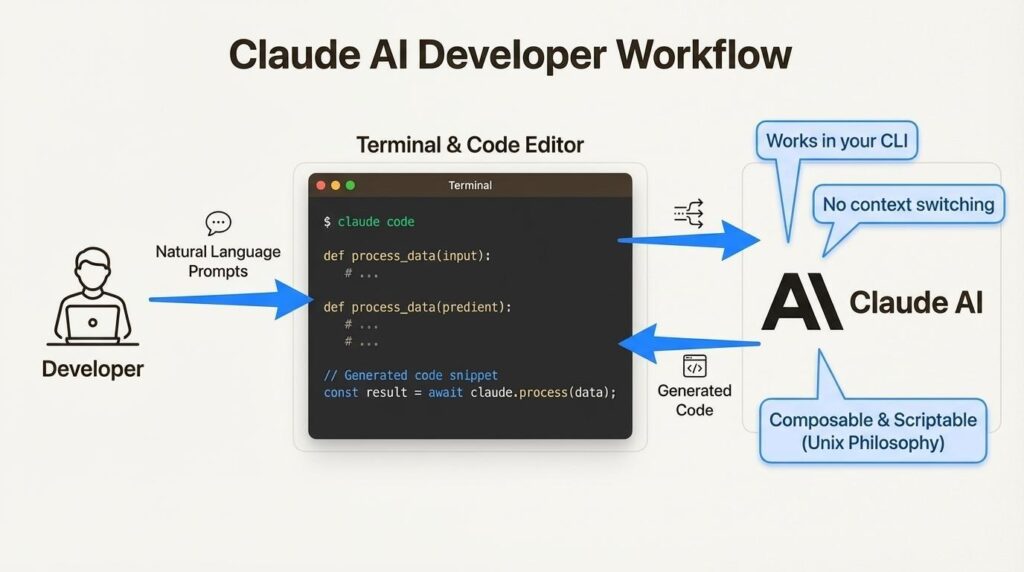
An empowered Claude-based system typically follows a layered architecture. At the top is the language model, which acts as the reasoning engine. Below it is a tool integration layer that allows interaction with APIs, file systems, and development environments. An execution layer enables the system to run commands or scripts, while a memory layer stores context and past interactions.
This architecture enables a continuous loop where Claude can interpret a task, generate a plan, execute it, and refine the result until the objective is achieved.
Core Capabilities in Development
When integrated into a development workflow, Claude can handle a wide range of tasks. It can generate backend APIs, create frontend components, and structure entire modules. It can analyze errors, identify root causes, and suggest or implement fixes. It can also refactor code, optimize performance, and explain complex logic in a clear and structured manner.
In addition, Claude can assist in writing documentation, generating test cases, and even preparing deployment scripts. Its strength lies in its ability to understand context and adapt its output accordingly.
Working Example: AI-Assisted API Development
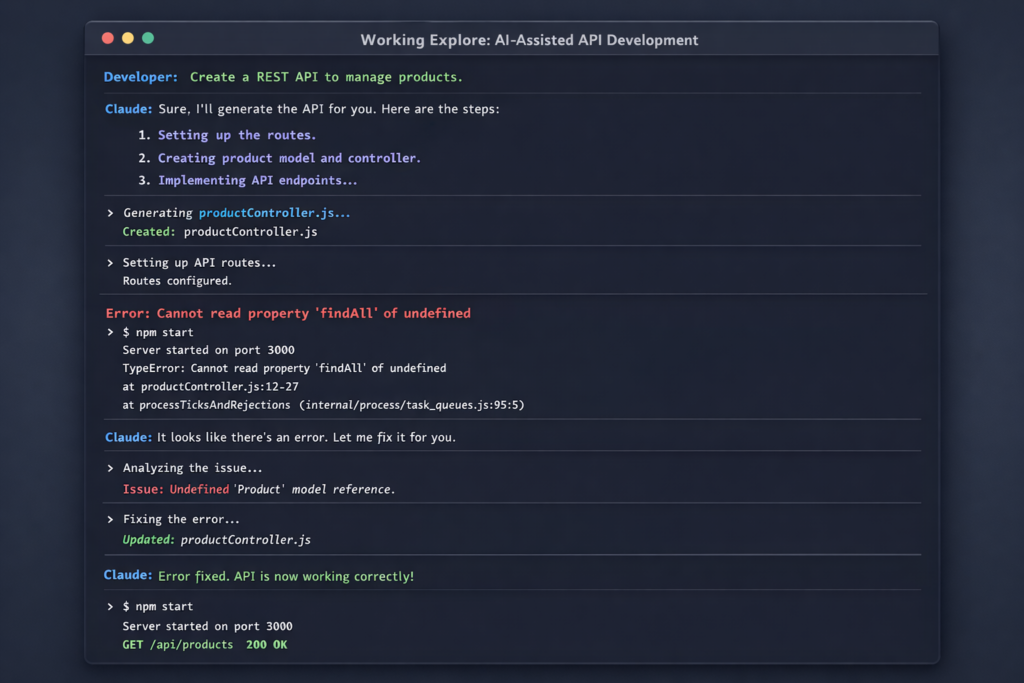
To illustrate how Claude can be used in a real development scenario, consider a case where a developer needs to build and debug an API.
The developer provides a goal such as creating a REST API for managing products. Claude interprets the requirement, generates the necessary code structure, and identifies the steps required to implement the API. If an error occurs during execution, Claude analyzes the issue and suggests corrections.
In a more advanced setup, Claude can be connected to a local environment where it executes commands, tests endpoints, and validates responses.
Practical Use Cases
Empowering Claude is particularly valuable in environments where speed and accuracy are critical. In backend development, it can generate and test APIs, reducing development time. In frontend development, it can create UI components and ensure consistency with design specifications. For DevOps workflows, it can assist in writing scripts, configuring environments, and automating deployments.
It is also useful for learning and onboarding, as it can explain code, provide examples, and guide developers through complex concepts.
Benefits
One of the key advantages of using Claude in development is increased productivity. By automating repetitive tasks and providing intelligent suggestions, it allows developers to focus on higher-level problem-solving. It also improves code quality by identifying potential issues early and suggesting best practices.
Another benefit is consistency. Claude can enforce coding standards and maintain uniformity across projects. This is particularly useful in team environments where multiple developers contribute to the same codebase.
Limitations and Considerations
Despite its capabilities, Claude is not a replacement for developers. Complex decision-making, architectural design, and domain-specific logic still require human expertise. The outputs generated by Claude may also need validation and refinement.
Security is another important consideration. When integrating Claude with execution environments, it is essential to control access and ensure that sensitive operations are handled securely.
Conclusion
Empowering Claude for development represents a significant step toward intelligent software engineering systems. By integrating AI with tools, execution layers, and memory, developers can create workflows where AI actively contributes to building, testing, and maintaining applications.
This approach transforms AI from a passive assistant into a collaborative system capable of handling real-world development tasks. As these systems continue to evolve, they are likely to become an integral part of modern software development practices.