
Introduction
As artificial intelligence becomes a core part of modern applications, developers and businesses are looking for faster ways to build, deploy, and manage AI-powered solutions. Traditional development approaches often require deep expertise in machine learning, infrastructure, and API integrations. This is where Dify comes into play.
Dify is an open-source platform designed to simplify the creation of AI applications by providing a low-code interface combined with powerful backend capabilities. It enables developers to build intelligent applications such as chatbots, workflows, and automation systems without managing complex AI pipelines from scratch.
What is Dify?
Dify is a platform that allows users to create AI-powered applications using large language models (LLMs) with minimal coding effort. It acts as a bridge between raw AI models and real-world applications by providing tools for prompt management, workflow orchestration, and API integration.
Instead of directly working with LLM APIs, developers can use Dify to design structured applications that are easier to maintain, scale, and deploy.
How Dify Works
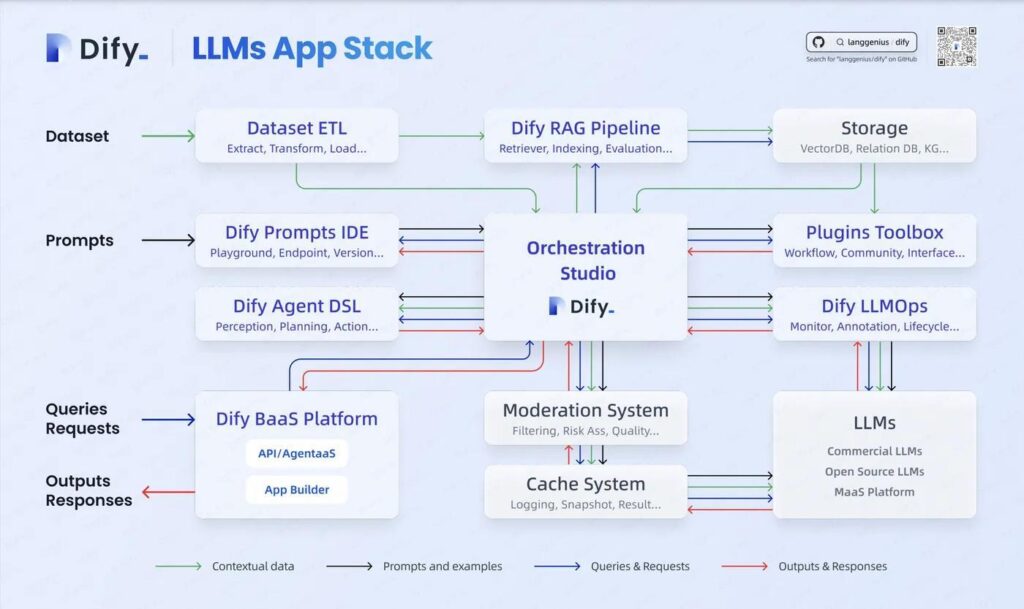
Dify operates through a layered architecture that simplifies AI development. At the core is the language model, which processes user input and generates responses. On top of this, Dify provides a prompt management system that allows developers to define how the AI should behave.
A workflow layer enables the creation of structured logic, where inputs can be processed, transformed, and routed through different steps. Additionally, Dify integrates with knowledge bases, allowing applications to retrieve and use external data for more accurate and contextual responses.
Core Features
Dify provides a comprehensive set of features that make AI development more accessible and efficient. It includes a visual interface for designing applications, allowing developers to configure prompts, workflows, and data sources without writing extensive code.
One of its key strengths is prompt engineering support. Developers can define system prompts, user prompts, and response formats, ensuring consistent and controlled AI behavior. Dify also supports integration with external APIs, enabling applications to perform actions beyond text generation.
Another important feature is knowledge base integration. By connecting documents or databases, Dify allows applications to provide context-aware responses, making it suitable for enterprise use cases.
Working Example Screenshot
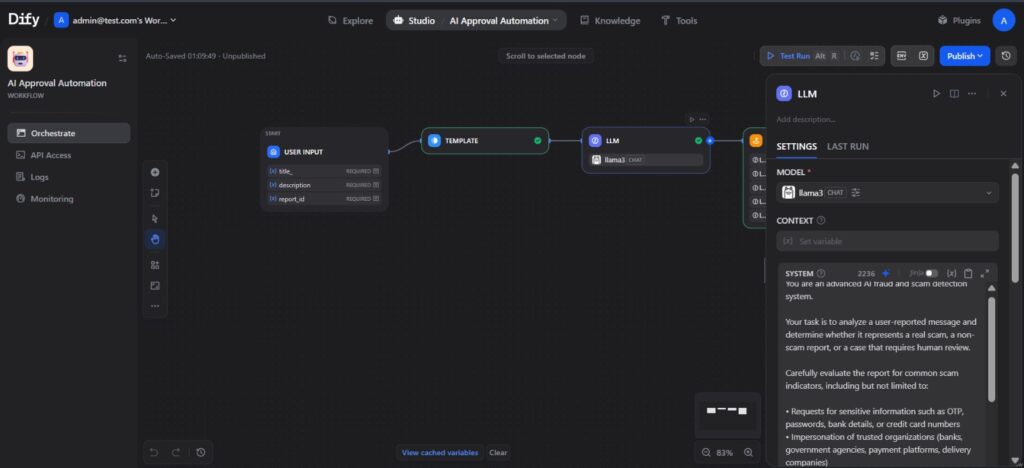
This screenshot shows a Dify workflow where user input (title, description, report ID) is processed through a structured template and analyzed by an LLM model. The AI is configured with a fraud detection prompt to classify reports as scam, non-scam, or requiring human review. It demonstrates how Dify enables building real-world AI automation using a visual workflow.
Practical Use Cases
Dify can be used across a wide range of applications. In customer support, it enables the creation of intelligent chatbots that can handle queries efficiently. In enterprise environments, it can be used to build internal knowledge assistants that help employees access information quickly.
For developers, Dify is useful for prototyping AI features, building SaaS products, and integrating AI capabilities into existing applications. It also supports automation workflows, making it suitable for tasks such as report generation, data processing, and content creation.
Benefits
One of the main advantages of Dify is its ability to reduce development complexity. By providing a structured platform, it eliminates the need to manage low-level AI integrations. This leads to faster development cycles and improved productivity.
Dify also enhances consistency by allowing developers to define and reuse prompts and workflows. This ensures that applications behave predictably and maintain quality across different use cases.
Another benefit is scalability. Applications built with Dify can be easily extended with additional features, integrations, and data sources.
Limitations
While Dify simplifies AI development, it does not completely replace traditional coding. Complex logic, custom integrations, and performance optimization may still require manual development.
Additionally, the quality of the output depends on how well prompts and workflows are designed. Poor configuration can lead to inconsistent or inaccurate results.
Conclusion
Dify represents a significant step forward in making AI application development more accessible and efficient. By combining low-code capabilities with powerful AI integrations, it enables developers to build intelligent systems without the overhead of managing complex infrastructure.
As AI continues to play a larger role in software development, platforms like Dify will become essential tools for creating scalable, maintainable, and intelligent applications.