
What OpenClaw Really Is
Artificial intelligence is undergoing a fundamental transition. For years, AI systems have been designed primarily to respond to user prompts, providing answers, suggestions, or generated content. While this capability has been transformative, it remains inherently limited. The next stage in AI evolution focuses not just on understanding and responding, but on acting. OpenClaw is a clear representation of this shift.
OpenClaw is an autonomous AI agent system that moves beyond traditional chatbot functionality. Instead of stopping at generating responses, it interprets user goals, plans a sequence of actions, executes them through integrated tools, and continuously refines its approach until the task is completed. This makes it closer to a digital worker than a conversational assistant.
The Evolution of OpenClaw
OpenClaw did not emerge in its current form overnight. It evolved through earlier versions known as Clawdbot and Moltbot. These iterations helped shape the core idea of an AI system capable of action rather than just interaction. The final transition to OpenClaw reflects both a refinement of the technology and a clearer articulation of its purpose.
This evolution highlights an important realization in AI development: intelligence without execution has limited value. While language models can reason effectively, their real-world usefulness increases significantly when they are connected to systems that allow them to perform tasks.
Core Idea — From Chatbot → Action Agent
Traditional AI:
User → Ask Question → AI → Answer
OpenClaw:
User → Give Goal → AI → Plan → Execute → Monitor → Improve

This is called an Autonomous Agent Loop
From Response-Based AI to Goal-Oriented Systems
Traditional AI systems operate in a linear manner. A user provides input, and the system generates an output. Each interaction is largely independent, and the system does not typically maintain continuity beyond the immediate context.
OpenClaw introduces a different paradigm. Instead of responding to isolated prompts, it works toward achieving defined goals. When a user provides a task, the system interprets it, breaks it down into smaller steps, and begins executing those steps. The process continues iteratively until the objective is fulfilled.
This shift changes the nature of interaction. The user is no longer asking questions but assigning objectives. The AI, in turn, becomes responsible for execution.
OpenClaw Architecture
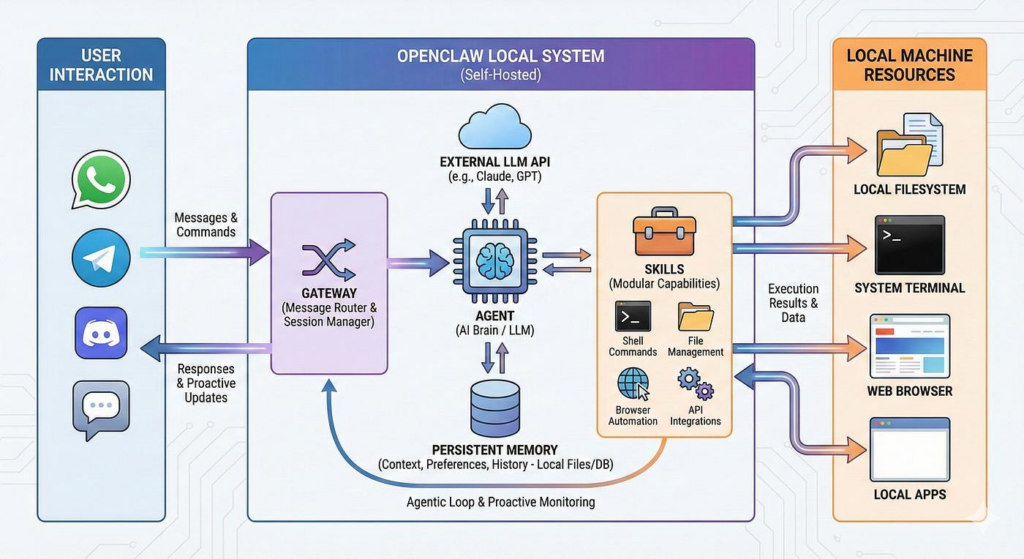
At the core of OpenClaw is a continuous operational loop that enables autonomy. The process begins when a user defines a goal. The language model acts as the reasoning engine, interpreting the goal and generating a plan. This plan is passed to an execution layer that interacts with various tools and systems. The outcomes of these actions are stored in memory, allowing the system to maintain context and refine its approach.
This loop can be understood as a cycle of planning, acting, observing, and improving. Unlike traditional systems that terminate after producing a response, OpenClaw continues operating until the task is completed or explicitly stopped.
Core Components
Language Model as the Decision Engine
The language model serves as the central intelligence of the system. It is responsible for understanding user intent, generating plans, and making decisions throughout the execution process. Its ability to reason and adapt is what enables the system to handle complex tasks.
Tool Integration Layer
One of the most critical aspects of OpenClaw is its integration with external tools. These tools extend the capabilities of the system beyond text generation. They allow the agent to interact with file systems, execute commands, call APIs, and perform various real-world actions. This layer effectively transforms the language model’s decisions into tangible outcomes.
Memory and Context Management
OpenClaw incorporates a memory mechanism that stores past interactions, decisions, and results. This enables the system to maintain continuity across tasks and improve its performance over time. Memory allows the agent to recall previous steps, avoid redundant actions, and build on prior knowledge.
Interaction Interface
The system is typically accessed through conversational interfaces such as messaging platforms. This design makes interaction intuitive while masking the complexity of the underlying processes. Users communicate goals in natural language, and the system handles the execution behind the scenes.
Practical Applications
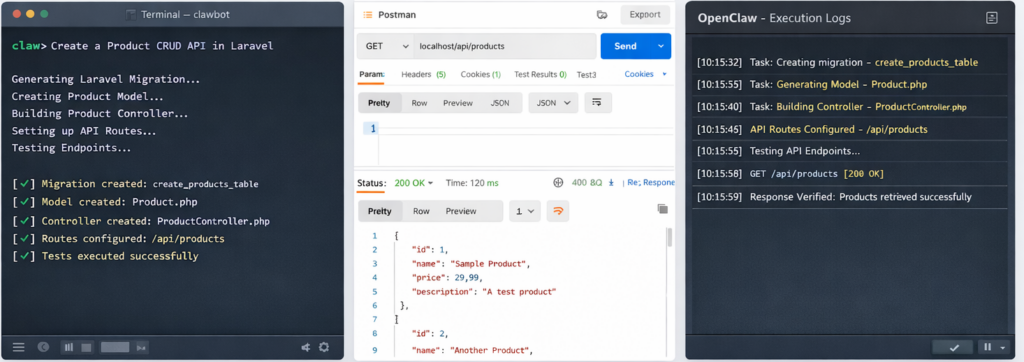
OpenClaw’s capabilities make it suitable for a wide range of use cases. In software development, it can automate repetitive tasks such as generating code structures, running commands, and testing APIs. It can assist in debugging by identifying issues and suggesting fixes, or even implementing those fixes directly.
In business environments, it can handle workflows such as email processing, report generation, and data analysis. It can also serve as a personal productivity tool, managing tasks, organizing files, and providing updates without constant user input.
What distinguishes these applications is not just automation, but adaptability. The system can adjust its approach based on context and feedback, making it more effective in dynamic environments.
AI-driven Laravel product CRUD automation
Working Example
Security and Risk Considerations
The autonomy and power of OpenClaw also introduce significant risks. Because the system can access local resources and execute commands, it has the potential to perform unintended or harmful actions. Misinterpretation of instructions, malicious inputs, or poorly configured permissions can lead to serious consequences.
Security considerations such as restricting access, validating inputs, and monitoring execution are essential. Developers must ensure that the system operates within controlled boundaries and that safeguards are in place to prevent misuse.
The Broader Implication
OpenClaw represents a broader trend in artificial intelligence: the transition from passive tools to active systems. Traditional AI systems assist users by providing information, but autonomous agents take responsibility for completing tasks.
This shift has implications for how software is designed and how users interact with technology. Instead of issuing commands step by step, users define objectives and allow the system to determine the best way to achieve them. This changes the role of AI from a tool to a collaborator.
Conclusion
OpenClaw demonstrates what is possible when language models are combined with execution capabilities, memory, and tool integration. It moves beyond the limitations of response-based systems and introduces a new paradigm of goal-oriented AI.
As this approach continues to evolve, it is likely to influence a wide range of applications, from software development to business automation. While challenges related to security and reliability remain, the potential benefits are substantial.
The transition from answering questions to executing tasks marks a significant step forward in the development of intelligent systems. OpenClaw stands as a strong example of this emerging direction.