Introduction
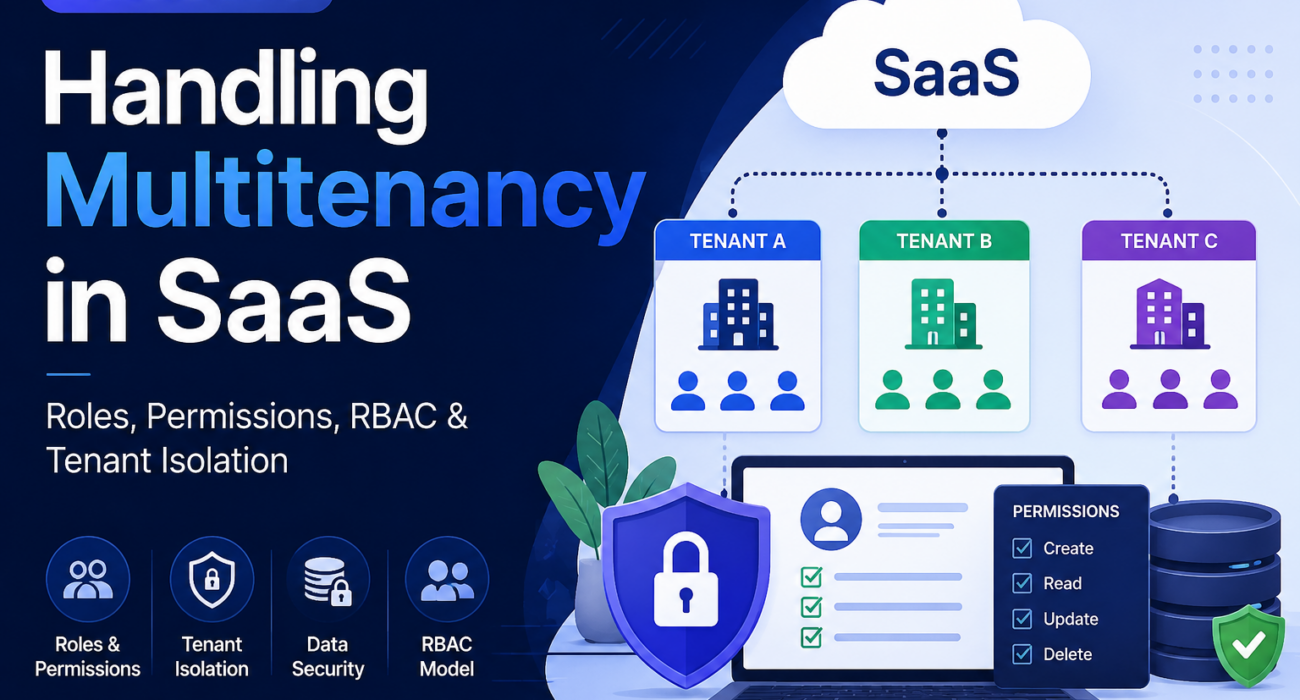
Multitenancy is one of the defining architectural challenges of SaaS products. When a single application instance serves hundreds or thousands of organizations simultaneously, every design decision—from database schemas to API middleware—must account for strict tenant isolation, flexible role hierarchies, and fine-grained permissions.
A well-designed multitenant architecture enables organizations to securely share infrastructure while ensuring complete separation of customer data and access controls.
The Core Problem
One of the biggest challenges in SaaS Multitenancy is designing a secure and scalable access control system that can support multiple organizations while maintaining strict data isolation.
Most SaaS applications start with a simple user model containing an email address, password, and perhaps an administrator flag. While this works initially, it quickly becomes insufficient as the platform grows and serves multiple tenants.
To build a secure multi-tenant architecture, three critical questions must be addressed:
- How do you guarantee that Tenant A can never access Tenant B’s data?
- How do you manage different user roles and permissions within each organization?
- How do you enforce permissions efficiently without excessive database lookups?
Getting these fundamentals right early helps prevent costly refactoring, reduces security risks, and creates a scalable foundation for SaaS growth.
Understanding Tenancy Models
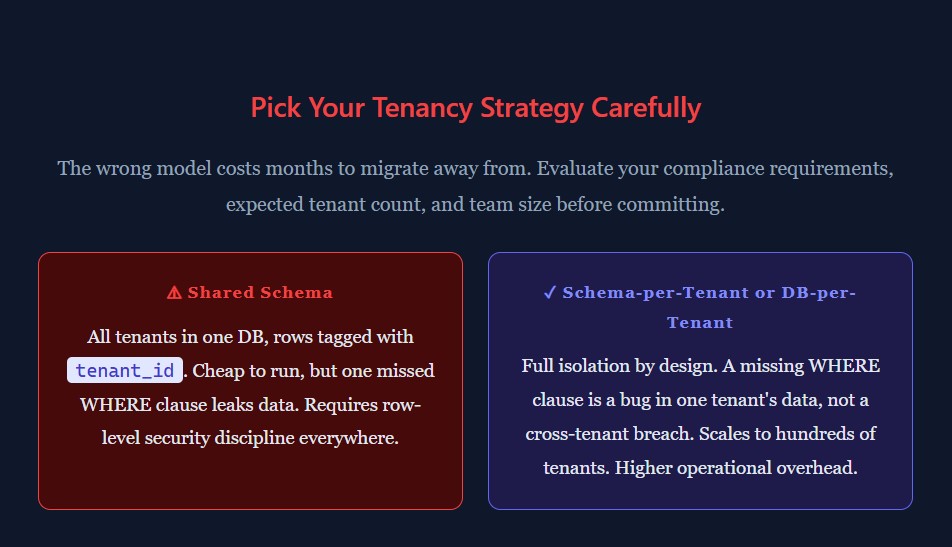
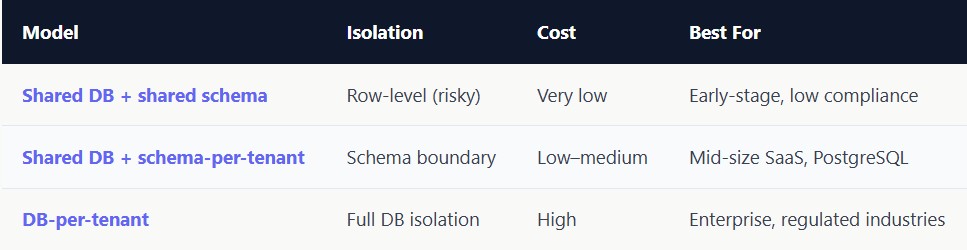
There are three common multitenancy approaches used in modern SaaS applications. Each model offers different levels of isolation, scalability, operational complexity, and cost.
1. Shared Database, Shared Schema
In this model, all tenants share the same database and tables, with records separated using a unique tenant identifier.
Advantages
- Low infrastructure cost
- Easy to manage and deploy
Disadvantages
- Higher risk of data leakage
- Requires strict tenant filtering in every query
2. Shared Database, Separate Schemas
In this approach, each tenant has its own database schema while sharing the same database instance.
Advantages
- Better tenant isolation
- Easier tenant-level management
Disadvantages
- Increased operational complexity
3. Database Per Tenant
Each tenant is allocated a completely separate database, providing the highest level of isolation.
Advantages
- Maximum data isolation
- Strong security and compliance support
Disadvantages
- Higher infrastructure and hosting costs
- More complex maintenance and monitoring
Choosing the right tenancy model depends on your application’s security requirements, scalability goals, compliance obligations, and operational budget.
Role-Based Access Control (RBAC)
Role-Based Access Control (RBAC) is a fundamental component of SaaS Multitenancy, enabling organizations to manage user access efficiently while maintaining strong security and tenant isolation.
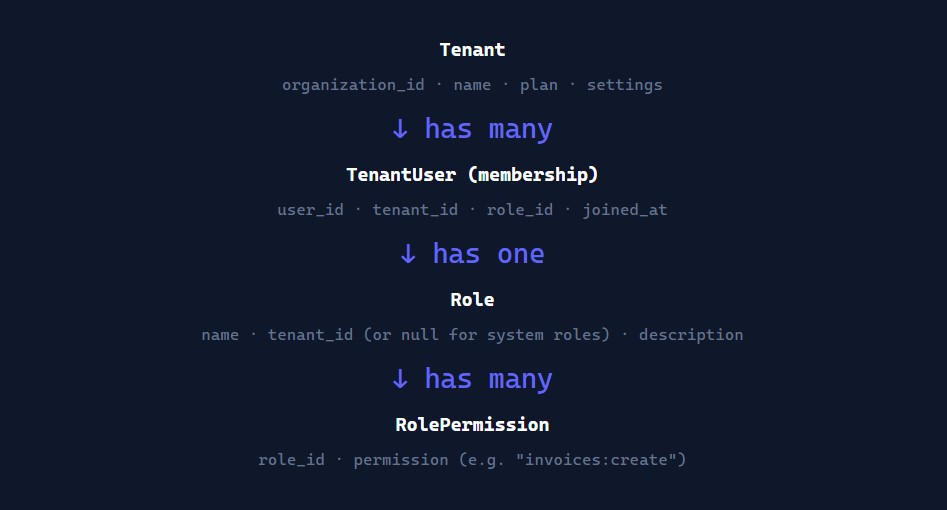
The core entities in an RBAC system include:
- Tenants
- Users
- Roles
- Permissions
In a multi-tenant environment, a user is assigned a role within a specific tenant rather than having a single role across the entire platform.
For example:
- User A can be an Admin in Company X.
- The same user can be a Viewer in Company Y.
This flexibility is essential for real-world SaaS environments, where users often belong to multiple organizations with different responsibilities and access requirements.
A well-designed RBAC model simplifies permission management, strengthens security, and provides a scalable foundation for growing SaaS applications.
Common SaaS Roles
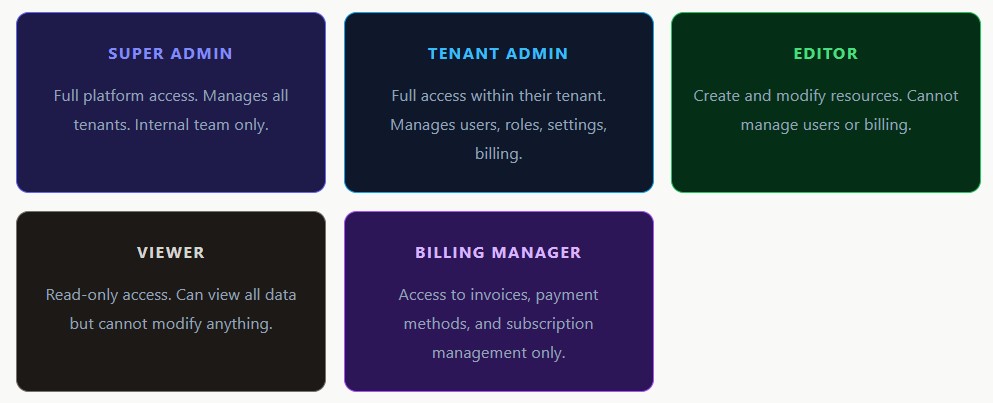
Most SaaS applications use a predefined set of roles to manage access and responsibilities within an organization. These roles help ensure that users have appropriate permissions based on their responsibilities.
Super Admin
The Super Admin is a platform-level role with full access across all tenants. This role is typically reserved for the internal SaaS team and is responsible for managing tenants, monitoring platform operations, and providing customer support.
Tenant Admin
The Tenant Admin has full administrative access within a specific organization. They can manage users, assign roles, configure settings, and oversee tenant-level operations.
Editor
Editors can create, update, and manage resources within the application. However, they do not have permission to manage users, roles, billing, or platform settings.
Viewer
Viewers have read-only access to organizational data. They can view information and reports but cannot make modifications or perform administrative actions.
Billing Manager
The Billing Manager is responsible for subscription management, invoice processing, payment methods, and other billing-related activities within the organization.
Defining clear roles helps organizations maintain security, simplify user management, and ensure that individuals only have access to the resources necessary for their responsibilities.
Permission Design Best Practices
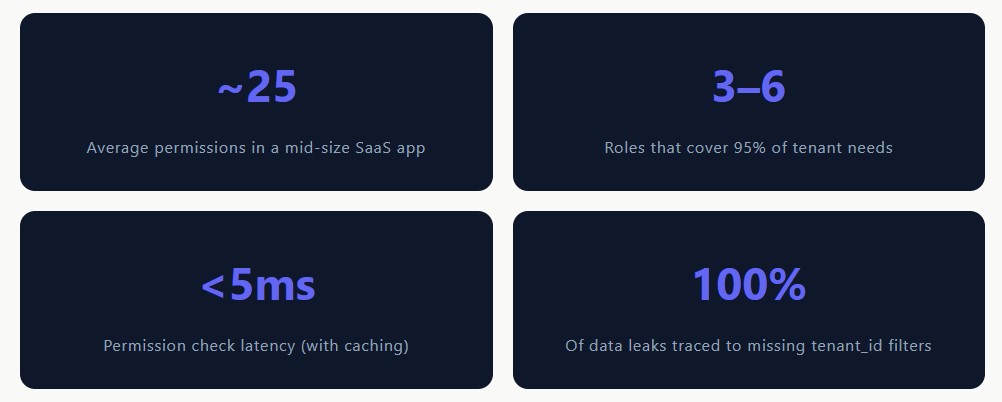
A well-designed permission structure is essential for maintaining security, scalability, and ease of management in a SaaS application. Permissions should follow a clear and consistent naming convention that accurately describes the action being performed on a specific resource.
A common and recommended approach is to use the resource:action format, such as:
invoices:createinvoices:readinvoices:updateinvoices:deleteusers:inviteusers:remove
This naming convention makes permissions easy to understand, manage, and audit across the application.
Avoid vague permissions such as:
admin_accessmanageaccess_all
Generic permission names often create confusion and make it difficult to determine what actions a user is actually allowed to perform.
Explicit permissions improve security, simplify troubleshooting, and provide greater flexibility when implementing Role-Based Access Control (RBAC) in a multi-tenant SaaS environment.
Tenant Context Resolution
Tenant Context Resolution is a critical component of SaaS Multitenancy, ensuring that every request is associated with the correct organization, user, and permission set before accessing application resources.
Each request should establish the following information:
- Who is the user?
- Which tenant is the user operating within?
- What permissions does the user have?
Resolving tenant context through middleware improves performance, strengthens tenant isolation, and simplifies Role-Based Access Control (RBAC) implementation across the application.
This approach ensures consistent authorization checks while reducing unnecessary database lookups and improving overall system scalability.
Permission Caching
In a SaaS Multitenancy architecture, permission checks occur frequently and can impact application performance if every authorization request requires a database lookup.
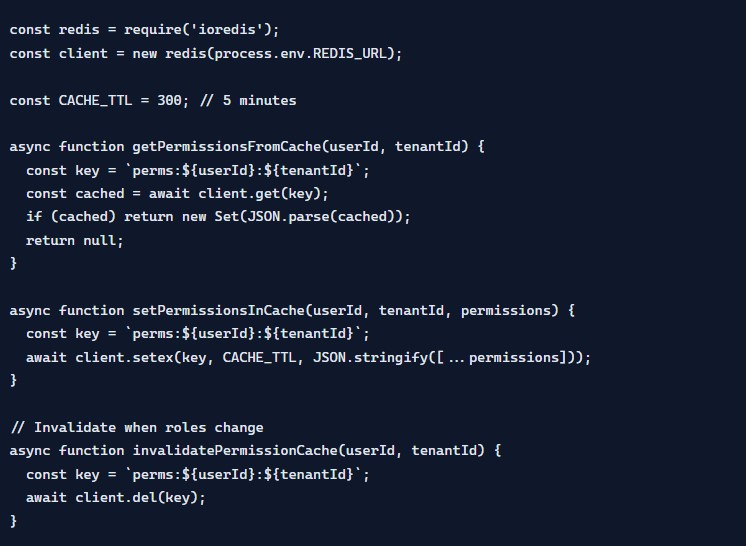
To improve performance and scalability, permission data should be cached using Redis or another high-performance caching solution.
Recommended caching practices include:
- Cache permissions using Redis
- Store permissions by User ID and Tenant ID
- Invalidate cached permissions immediately when roles or permissions change
Caching permissions reduces database load, improves response times, and enables efficient Role-Based Access Control (RBAC) implementation in large-scale SaaS applications.
Proper cache invalidation is essential because stale permissions can become a security vulnerability and compromise tenant isolation.
Row-Level Security (RLS)
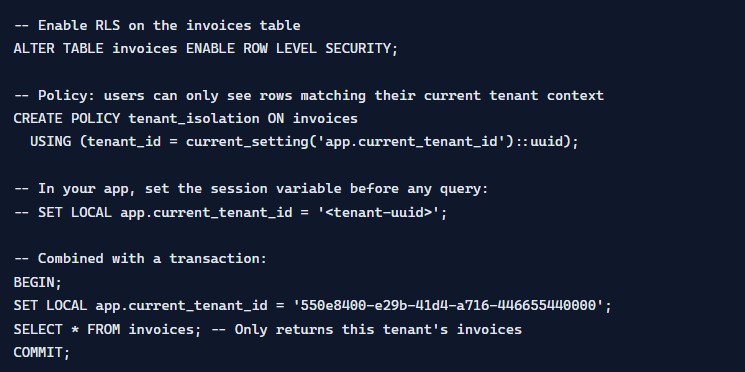
In a SaaS Multitenancy architecture, PostgreSQL Row-Level Security (RLS) provides a powerful database-level mechanism for enforcing tenant isolation and protecting sensitive data.
Instead of relying entirely on application logic, RLS ensures that users can only access rows associated with their authorized tenant context.
Benefits include:
- Database-enforced tenant isolation
- Reduced risk of accidental data exposure
- Protection against missing tenant filters in application code
By enforcing access policies directly within the database, RLS strengthens security, improves compliance, and reduces the likelihood of cross-tenant data leaks.
As a result, Row-Level Security serves as a critical last line of defense, helping maintain secure and reliable multi-tenant SaaS applications even when application-level safeguards fail.
User Invitations
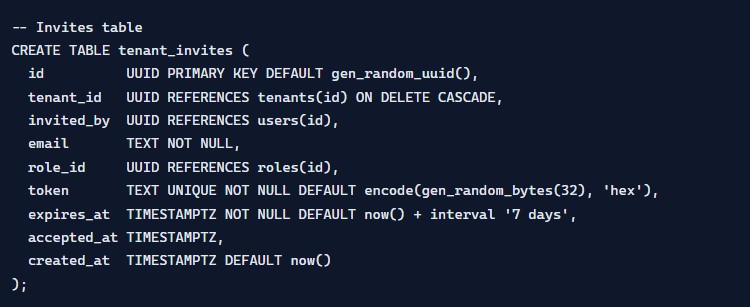
In a SaaS Multitenancy environment, user invitations must be carefully managed to ensure that new users are added to the correct tenant while maintaining security and tenant isolation.
Tenant invitations should:
- Be scoped to a specific tenant
- Expire after a defined period
- Create memberships atomically
- Prevent duplicate invitations
A secure invitation workflow improves user management, streamlines onboarding, and helps maintain the integrity of tenant access controls.
Implementing token-based invitations, expiration policies, and membership validation ensures that only authorized users can join an organization and access its resources.
Super Admin vs Tenant Admin
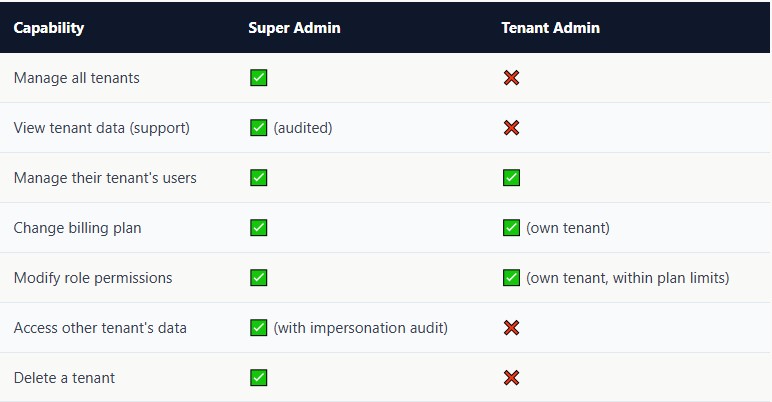
In a SaaS Multitenancy architecture, Super Admin and Tenant Admin roles have distinct responsibilities and should never be treated as equivalent. Proper role separation is critical for maintaining security, governance, and tenant isolation.
Super Admin
The Super Admin is a platform-level role typically reserved for the SaaS provider’s internal team.
- Manage all tenants across the platform
- Access platform-wide settings and configurations
- Provide customer support and troubleshooting
- Perform security reviews and compliance audits
Tenant Admin
The Tenant Admin is responsible for managing resources within a specific organization.
- Manage users within their organization
- Configure tenant-specific settings
- Manage billing and subscription details
Clearly separating these responsibilities reduces the risk of privilege escalation, strengthens tenant isolation, and ensures secure access control across the SaaS platform.
Testing Tenant Isolation
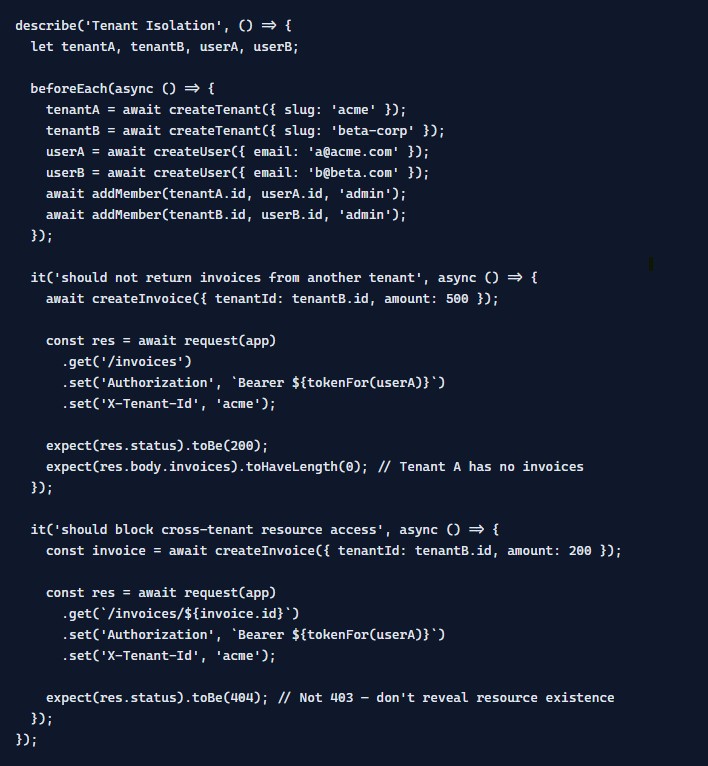
In a SaaS Multitenancy architecture, tenant isolation must be continuously verified through automated testing to ensure that users can only access data and resources belonging to their organization.
Common tenant isolation test scenarios include:
- Preventing cross-tenant data access
- Validating tenant-scoped APIs
- Ensuring unauthorized requests return appropriate responses
These tests confirm that access controls, tenant filters, and authorization mechanisms are functioning correctly across the application.
By automating tenant isolation testing, development teams can identify security issues before deployment, strengthen data protection, and maintain trust in their multi-tenant SaaS platform.
Build vs Buy
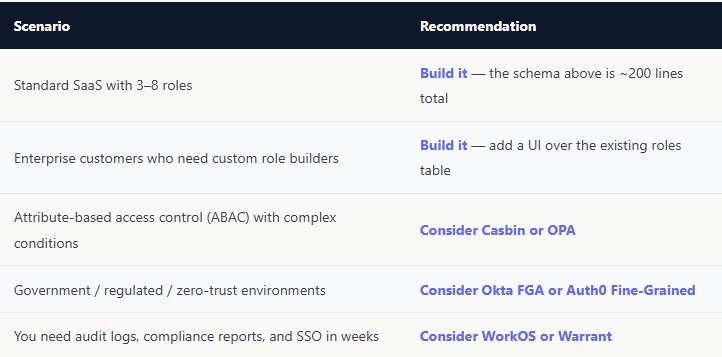
In a SaaS Multitenancy architecture, organizations must decide whether to build authorization systems internally or leverage specialized third-party solutions. This decision can significantly impact development speed, maintenance costs, and long-term scalability.
Build Internally
Building an authorization system in-house is typically recommended for:
- Standard SaaS products
- Moderate role and permission complexity
- Custom business requirements
This approach offers maximum flexibility and allows teams to tailor Role-Based Access Control (RBAC) to their specific business needs.
Consider Third-Party Solutions
Organizations with complex authorization requirements may benefit from dedicated access control platforms such as:
- Okta Fine-Grained Authorization
- Auth0
- WorkOS
- Casbin
- Open Policy Agent (OPA)
These solutions can accelerate development, simplify compliance efforts, and provide advanced authorization capabilities for enterprise-grade applications.
Selecting the right approach depends on your application’s complexity, security requirements, compliance obligations, and available engineering resources.
Conclusion
Building a secure multi-tenant SaaS platform requires careful planning around tenant isolation, Role-Based Access Control (RBAC), permission management, and database security. These foundational components play a critical role in ensuring that organizations can securely share infrastructure while maintaining strict separation of data and access controls.
By implementing a robust RBAC model, tenant-aware middleware, permission caching, automated testing, and PostgreSQL Row-Level Security (RLS), organizations can create scalable systems that remain secure, maintainable, and performant as they grow.
A well-designed multitenancy architecture not only strengthens security and compliance but also simplifies user management, improves operational efficiency, and supports long-term business growth.
When implemented correctly, SaaS Multitenancy becomes a powerful foundation that enables applications to scale efficiently while maintaining security, compliance, reliability, and operational excellence.